
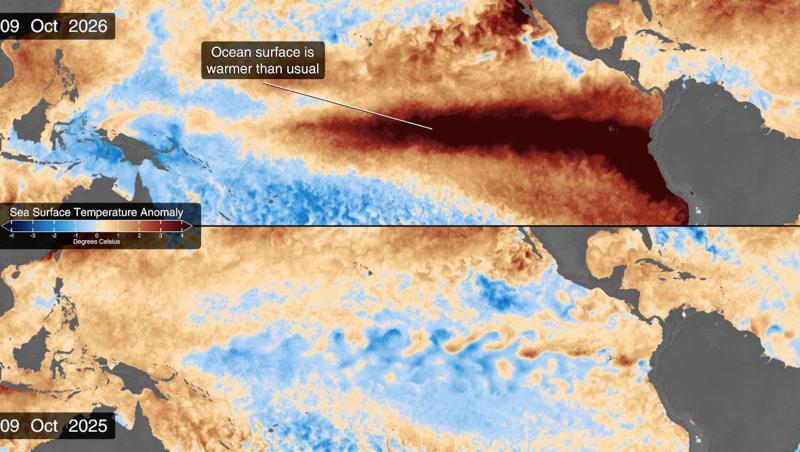
A potentially powerful El Niño phenomenon is raising concerns about record-breaking ocean temperatures in the Pacific, with changes in the sea’s colour highlighting the growing pressure on marine ecosystems.
El Niño is a natural climate pattern characterised by unusually warm sea surface temperatures in the central and eastern tropical Pacific. When particularly strong, the phenomenon can disrupt weather patterns worldwide and trigger significant changes in ocean conditions.
The dramatic colour shift reported in parts of the Pacific may reflect changes in microscopic marine organisms, including phytoplankton, which form the foundation of the ocean food chain.
These tiny organisms absorb carbon dioxide and provide food for fish and other marine species. Changes in their abundance can therefore affect the wider marine ecosystem, from small fish to larger predators.
Rising sea temperatures can also place coral reefs under severe stress, increasing the risk of coral bleaching when corals expel the algae that provide much of their energy and colour.
The potential consequences extend beyond marine wildlife. Fishing communities that depend on healthy ocean ecosystems could face declining catches or changes in the distribution of commercially important fish species.
El Niño can also contribute to extreme weather, including droughts in some regions and heavy rainfall in others, depending on how the atmospheric circulation responds to warming in the Pacific.
Scientists monitor sea surface temperatures, ocean colour and changes in marine productivity to assess the phenomenon’s development and potential impacts.
Although the term “Super El Niño” is used to describe an exceptionally strong event, its classification and severity depend on observed ocean temperatures and atmospheric conditions. A change in ocean colour alone is not sufficient to establish the strength of an El Niño event.
As monitoring continues, the key concern is whether sustained ocean warming will intensify pressure on already vulnerable marine ecosystems, with consequences for biodiversity, fisheries and communities that rely on the sea.
Super El Niño’ Threatens Pacific Marine Life as Ocean Temperatures Soar
A potentially powerful El Niño phenomenon is raising concerns about record-breaking ocean temperatures in the Pacific, with changes in the sea’s colour highlighting the growing pre...
By editor·October 19, 2026·2 min read
16
More in environment

environmenteditor
Congo Ebola outbreak threatens to become deadliest in history
The World Health Organization (WHO) has warned that the rapidly spreading Ebola outbreak in the Democratic Republic of C…
120 1

environmenteditor
New coronavirus with potential to cause pandemic discovered in China
Another coronavirus feared to be powerful enough to spread through humans has been discovered in China. In scenes eerily…
198 0
environmenteditor
PLASTIC POLLUTION IN LAKE MALAWI; CAUSES, CONSEQUENCES AND SOLUTIONS
Global concerns around the impacts of plastic use on the world’s eco-system and human well-being have been growing rapid…
156 0