
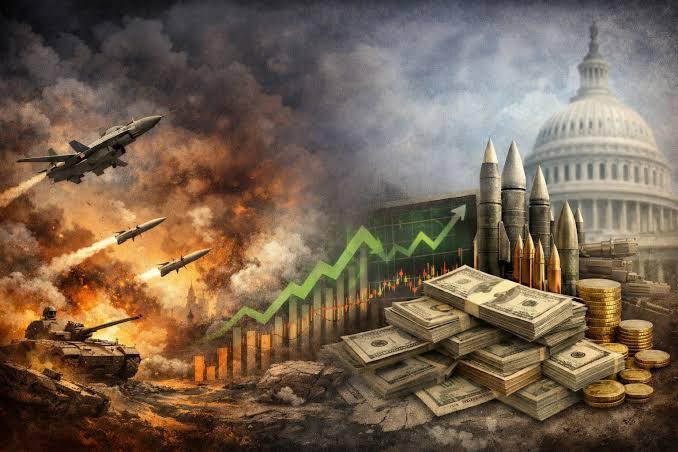
From deadly drone strikes in Ukraine to attacks on shipping in the Middle East and escalating economic competition between Washington and Beijing, global tensions are unfolding on multiple fronts. But do these developments amount to a new world war?
Russian strikes across Ukraine killed at least eight people and injured about 60, while attacks disrupted electricity supplies to more than one million people, Reuters reported. The strikes targeted several regions, demonstrating how drones and missiles are being used against infrastructure far from the frontline.
Meanwhile, military tensions involving Iran, Israel and the United States have extended beyond land-based targets to maritime security, with attacks on commercial vessels raising concerns about energy supplies and international trade.
These are separate conflicts and rivalries, but their consequences increasingly reach across national borders.
The missile and drone wars
Ukraine provides a clear example of the changing nature of warfare. Russia has repeatedly attacked Ukrainian energy infrastructure, while Ukraine has conducted long-range strikes against Russian oil facilities.
On October 14, Russian strikes damaged dozens of energy facilities in Ukraine, killing three people and leaving hundreds of thousands without electricity, according to Reuters.
The attacks show how drones and missiles can disrupt essential services as well as military operations. They also illustrate the cycle of attacks and retaliation that has prolonged the conflict.
Economic wars: Power beyond the battlefield
The United States and China are competing over trade, technology and strategic industries, including semiconductors and solar manufacturing.
In August 2026, Washington announced new trade measures targeting polysilicon imports to strengthen domestic production of materials used in solar panels and semiconductors. The measures included a 15 per cent tariff scheduled to take effect in December.
Such measures are not military attacks, but they demonstrate how governments use trade policy to protect strategic industries and reduce dependence on competitors.
The consequences can extend to manufacturers, investors and consumers in countries that rely on international supply chains.
The superpower rivalry
The United States, China and Russia have competing security and economic interests, but they are not engaged in one common war.
Russia's invasion of Ukraine has strained relations with Western governments, while US-China competition continues across trade, technology and military security.
Even relations between allies can become strained. On October 17, Reuters reported that disagreements between US President Donald Trump and Ukrainian President Volodymyr Zelenskyy were raising concerns about the future of American support for Kyiv.
These developments matter because military assistance, diplomatic partnerships and economic decisions can influence the duration and direction of international conflicts.
Why Malawi should pay attention
Global conflicts can affect Malawi through fuel prices, shipping costs and the price of imported goods.
Threats to shipping in the Strait of Hormuz and the Red Sea can disrupt important trade routes. For an import-dependent, landlocked country such as Malawi, higher international energy and transport costs can add pressure to businesses and household budgets.
However, the extent of any impact depends on the duration of disruptions, global prices, supply arrangements and domestic pricing factors. Not every increase in local prices can be attributed to international conflict.
So, are we already living through World War III?
There is no established basis for declaring that World War III has begun. The term traditionally describes large-scale armed conflict involving major powers and their allies across multiple regions.
However, what is clear is that the world is experiencing active wars, drone and missile attacks, economic restrictions and strategic competition between major powers.
These developments do not constitute a single global war, but escalation in one conflict can affect other countries through alliances, trade, energy markets and military intervention.
Are We Unknowingly Living Through World War III? Economic Wars, Missiles and Superpower Rivalries
From deadly drone strikes in Ukraine to attacks on shipping in the Middle East and escalating economic competition between Washington and Beijing, global tensions are unfolding on ...
By editor·October 17, 2026·3 min read
17
More in opinion feature

opinion featureeditor
POST ANALYSIS: USA 'YELLOW LIST'S' MALAWI
It has been days that Malawians planning to travel to USA for business, school or pleasure have been uncertain of their…
329 0
opinion featureeditor
ILLEGAL GUNS, VOTES AND POST ELECTIONS VIOLENCE
Concerns about public safety are growing as the country draws near to its general elections this year with the public se…
176 0
opinion featureeditor
JACKPOT TO DEPRESSION, POVERTY AND SUICIDES: THE UNTOLD STORIES BEHIND GAMBLING
In a country where it's economy continues to struggle amidst devastating cyclones, rising inflations and a protracted ma…
226 0