
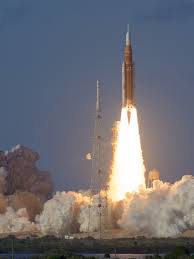

The NASA has successfully launched its first crewed lunar mission in over five decades, as Artemis II lifted off from Kennedy Space Center in Florida on April 1, 2026.
The powerful Space Launch System rocket carrying the Orion spacecraft blasted off at approximately 6:35 p.m. Eastern Time, following a launch window that opened at 6:24 p.m. The mission had backup launch opportunities scheduled between April 2 and April 6 in case of delays, but proceeded as planned on its primary date.
In the final hours leading to liftoff, mission controllers conducted a series of critical countdown procedures, including fueling operations with liquid hydrogen and oxygen, comprehensive systems checks, and weather assessments. A final “go/no-go” poll was conducted minutes before launch, clearing the mission for liftoff at T-0 as the rocket ignited and ascended into the evening sky.
The mission carries four astronauts — Reid Wiseman, Victor Glover, Christina Koch and Jeremy Hansen — on a 10-day journey that will take them around the Moon and back to Earth. The crewed flight marks the first time humans have ventured into deep lunar space since the Apollo program era, underscoring a significant milestone in modern space exploration.
Unlike earlier Moon missions that focused on landing, Artemis II is designed as a test flight to evaluate critical systems needed for future human landings. The Orion spacecraft is expected to travel approximately 400,000 kilometres from Earth, performing a lunar flyby and passing around the far side of the Moon before returning for a planned splashdown in the Pacific Ocean.
The mission is part of NASA’s broader Artemis program, which seeks to establish a sustainable human presence on the Moon and lay the groundwork for future missions to Mars. Artemis II follows the successful uncrewed Artemis I mission conducted in 2022 and is a key step toward the planned Artemis III mission, which aims to land astronauts on the lunar surface later this decade.
The launch represents not only a technological achievement but also a symbolic return to deep space exploration, positioning NASA and its international partners at the forefront of a new era of human spaceflight.